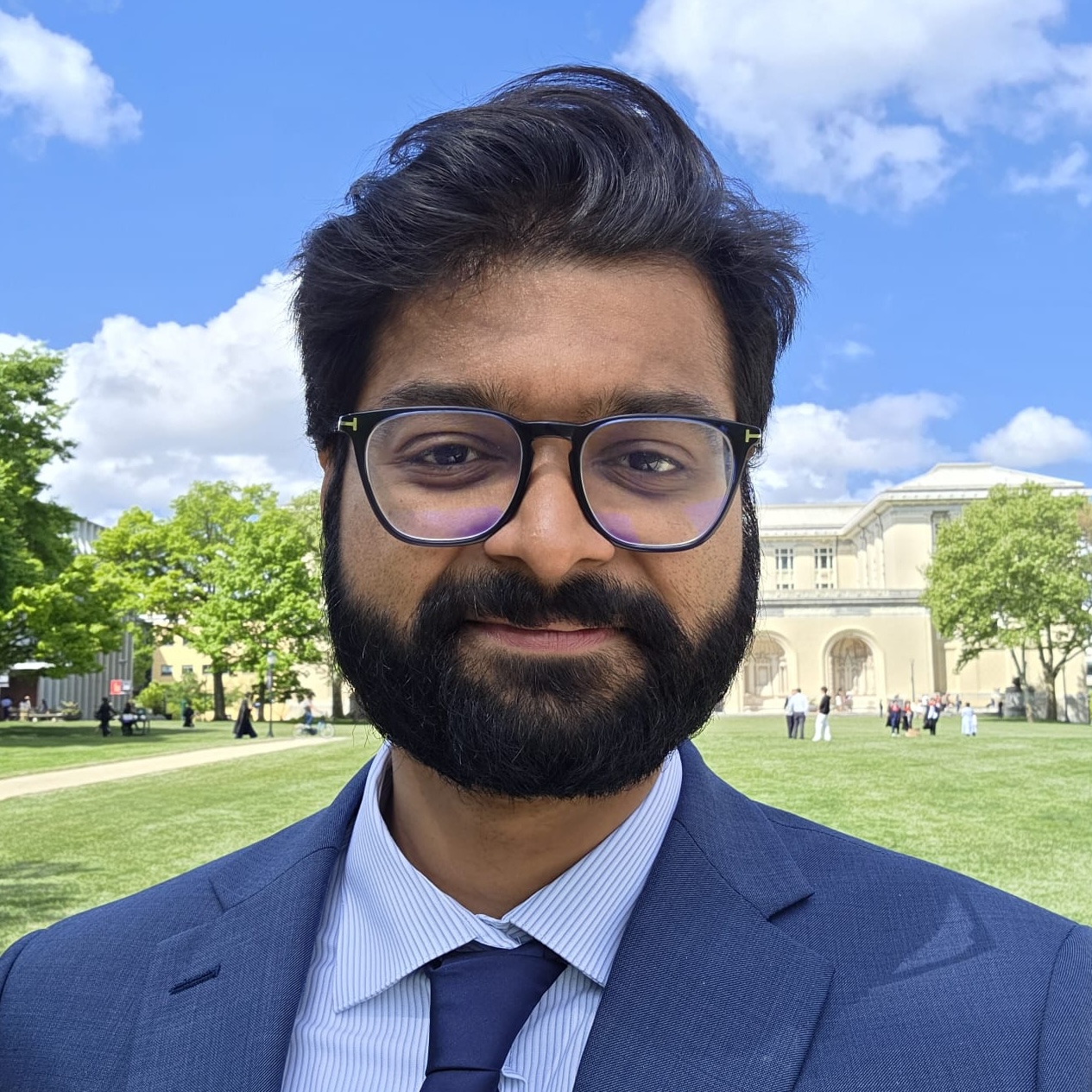
3D Perception for Agentic Robotics
I am a post-doctoral research fellow at Caltech working with Georgia Gkioxari. Previously, I completed my PhD in Robotics at CMU with Deva Ramanan. I was supported in part by a NSF Graduate Research Fellowship.
Research
My research focuses on developing 3D foundation models for robotic manipulation. My current work leverages agentic real-to-sim-to-real pipelines, large-scale reinforcement learning, and geometric priors to train dynamic, precise, and adaptive models. Previously, during my PhD, I developed scalable open-world perception systems for 3D motion understanding and promptable 3D semantics. I also worked on long-tailed 3D object detection, few-shot multimodal alignment for vision-language models, and real-time object detection.
Formal Biography
Neehar Peri is a Postdoctoral Research Fellow at Caltech working at the intersection of computer vision and robotics. His research focuses on developing 3D foundation models for robotic manipulation, leveraging agentic real-to-sim-to-real pipelines, large-scale reinforcement learning, and geometric priors to build dynamic, precise, and adaptive models. His recent work spans agentic robotics for manipulation and quadruped locomotion, LiDAR scene flow, open-vocabulary 3D detection, and few-shot alignment for vision-language models, including a Best Paper Award Candidate at CVPR 2026. He received his PhD in Robotics at CMU with Deva Ramanan, supported in part by an NSF Graduate Research Fellowship.Recent News
- [October 2026] Our paper Long-Tailed 3D Detection via Multi-Modal Fusion has been accepted to IJCV 2026
- [August 2026] Our paper OV3D-Bench: A Diagnostic Benchmark for Open-Vocabulary Monocular 3D Detection has been accepted to OpenSUN3D @ ECCV 2026
- [June 2026] Our paper DetPO: In-Context Learning with Multi-Modal LLMs for Few-Shot Object Detection has been accepted to ECCV 2026
- [June 2026] Our paper UniFlow: Zero-Shot LiDAR Scene Flow for Autonomous Driving has been accepted to ECCV 2026
- [April 2026] I was selected to particpate in the CVPR 2026 Doctoral Consortium
- [February 2026] Our paper RefAV: Towards Planning-Centric Scenario Mining has been accepted to CVPR 2026
- [January 2026] Our paper RF-DETR: Neural Architecture Search for Real-Time Detection Transformers has been accepted to ICLR 2026
Show More
- [September 2025] Our paper Roboflow100-VL: A Multi-Domain Object Detection Benchmark for Vision-Language Models has been accepted to NeurIPS D&B 2025
- [June 2025] Our paper MonoFusion: Sparse-View 4D Reconstruction via Monocular Fusion has been accepted to ICCV 2025
- [May 2025] Our paper Towards Learning to Complete Anything in LiDAR has been accepted to ICML 2025
- [February 2025] Our paper QuickDraw: Fast Visualization, Analysis and Active Learning for Medical Image Segmentation has been accepted to HCII 2025
- [January 2025] Our paper Planning with Adaptive World Models for Autonomous Driving has been accepted to ICRA 2025
- [January 2025] Our paper Neural Eulerian Scene Flow Fields has been accepted to ICLR 2025
- [September 2024] Our paper Revisiting Few-Shot Object Detection with Vision-Language Models has been accepted to NeurIPS D&B 2024
- [September 2024] Our paper Shelf-Supervised Cross-Modal Pre-Training for 3D Object Detection has been accepted to CoRL 2024
- [July 2024] Our paper Better Call SAL: Towards Segmenting Anything in LiDAR has been accepted to ECCV 2024
- [July 2024] Our paper I Can't Believe It's Not Scene Flow has been accepted to ECCV 2024
- [May 2024] Our paper Semi-Supervised Federated Multi-Organ Segmentation with Partial Labels has been accepted to AAPM 2024
- [January 2024] Our paper ZeroFlow: Scalable Scene Flow via Distillation has been accepted to ICLR 2024
- [August 2023] Our paper An Empirical Analysis of Range for 3D Object Detection has been accepted to BRAVO @ ICCV 2023
- [March 2023] I was awarded the NSF Graduate Research Fellowship
- [March 2023] Our paper ReBound: An Open-Source 3D Bounding Box Annotation Tool for Active Learning has been accepted to AutomationXP @ CHI 2023
- [January 2023] Our paper Data and Algorithms for End-to-End Thermal Spectrum Face Verification has been accepted to TBIOM 2022
- [September 2022] Our paper Towards Long Tailed 3D Detection has been accepted to CoRL 2022
- [August 2022] Our paper A Brief Survey of Person Recognition at a Distance has been accepted to ACSSC 2022
- [March 2022] Our paper Forecasting from LiDAR via Future Object Detection has been accepted to CVPR 2022
- [February 2022] Our paper Assessment of a Novel Virtual Environment for Examining Human Cognitive-Motor Performance during Execution of Action Sequences has been accepted to HCII 2022
- [October 2021] Our paper A Synthesis-Based Approach for Thermal-to-Visible Face Verification has been accepted to FG 2021
- [September 2021] Our paper PreferenceNet: Encoding Human Preferences in Auction Design with Deep Learning has been accepted to NeurIPS 2021
- [May 2021] I was selected as one of Maryland's Undergraduate Researchers of the Year
- [May 2021] I was awarded the Sujan Guhan Memorial Best Senior Thesis by UMD's ECE Department
- [December 2020] I was awarded an honorable mention for the Computing Research Association's Outstanding Undergraduate Researcher Award